Thank you for your interest in the application for a new Battery Energy Storage System (BESS) at Astwood Lane in Feckenham.
Achieving Net Zero is dependent on grid scale transition to renewable energy, (wind & solar) which in turn is dependent on grid scale energy storage to ensure efficient, stable and secure energy supply to customers.
When renewable energy generation exceeds customer demand, this facility will store and discharge it back into the grid when demand exceeds supply, reducing curtailment costs (£1 billion per annum – 2023/24) and stabilising supply, literally keeping the lights on.
This proposal is temporary, (40 yrs) following which the land will be restored. As of 2024, the UK had 4.5GW of installed energy storage, this needs to increase to 23-27GW by 2030 to support the shift to low carbon and renewable energy. This will necessitate 3GW of installed, operational ESS capacity coming online every year, almost double the highest annual installation so far – 1.7GW of installed capacity was achieved in 2023.
The map below shows the location of the proposed BESS.
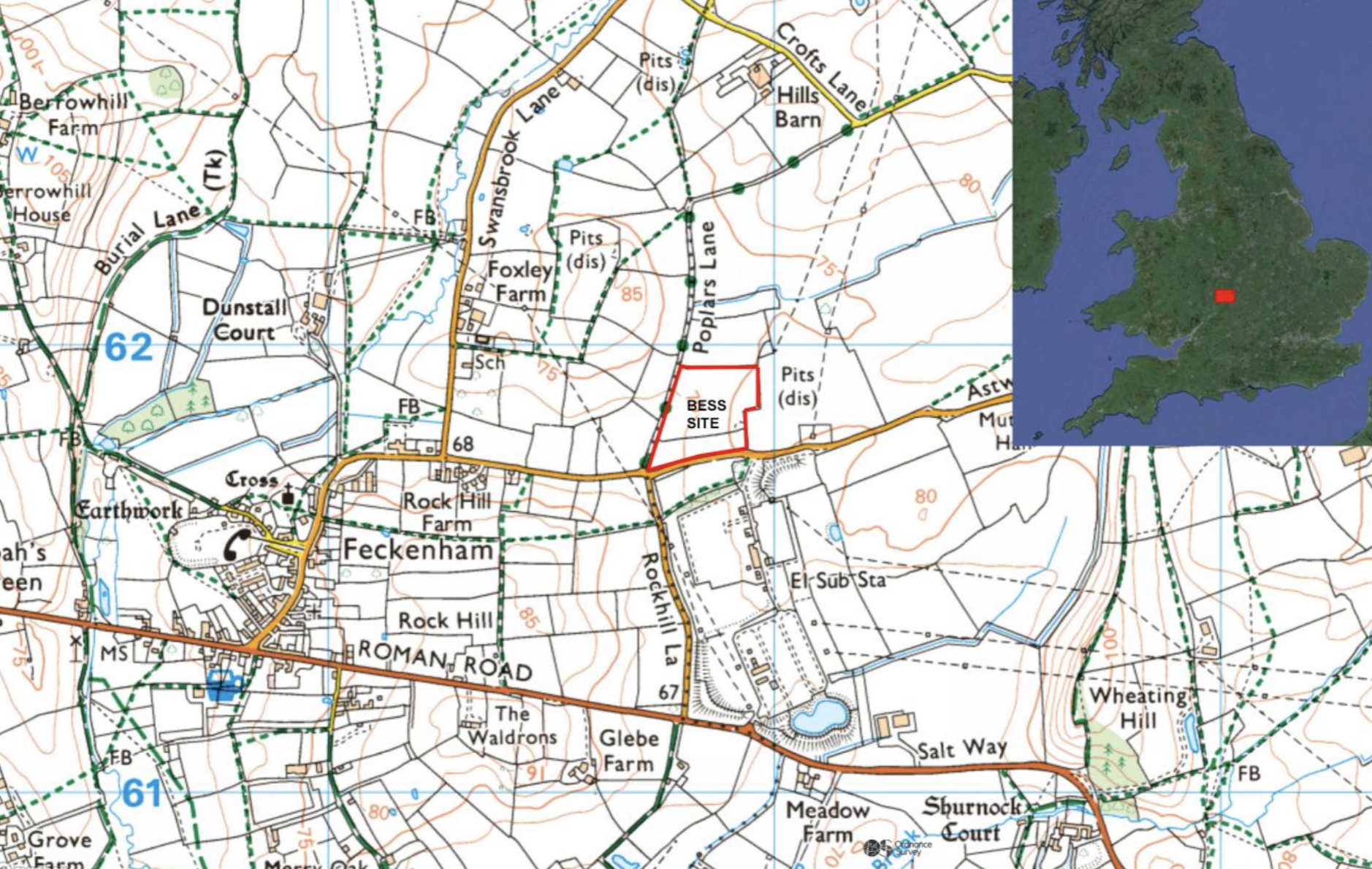
The application site includes part of an agricultural field located north of Astwood Lane and east of Poplars Lane (north-east of Feckenham). The site is bordered by hedgerows and trees and sits opposite the Feckenham substation (south of Astwood Lane).
The site is accessed from the south via Astwood Lane, which provides access onto the B4090 Alcester Road (Salt Way) and connection to the M5 at Junction 5. The site sits within a rural setting charactertised by both open agricultural land and existing energy infrastructure.
Planning permission is sought for a 100MW BESS with associated infrastructure, including a new access road from Astwood Lane. The scheme comprises of a series of battery cabinets and 3.8MW converters arranged along the western part of the site. Associated infrastructure would be arranged adjacent to the battery cabinets and enclosed within a compound fence. Landscape planting is proposed to the front of the site in the form of scrub planting.
The batteries themselves are housed in cabinets and are up to a maximum of 3.5m in height. The site will be surrounded by green v-mesh security fencing. Much of the appearance of the site and equipment is functional and dictated by operational or health and safety requirements. However, soft landscaping will be introduced around the compound to help soften the visual impact.
The application is for a temporary 40 year use. The proposed development site would then be decommissioned, and the site restored to its former agricultural use. The decommissioning would include the removal of any elements which had been secured through the planning permission, including the BESS compound area, access track, and any landscaping/planting proposed for screening purposes, to ensure that the development site would be fully restored to its former use as agricultural land, with the exact details to be confirmed prior to the decommissioning process beginning.
BESS are now considered a key component to unlocking the full potential of intermittent renewable energy – the more renewable energy that is connected, the more important the ability to manage its intermittent nature becomes. BESS systems offer the ability to stabilise and balance. This type of facility operates by taking electricity from the Grid at times of low demand, storing it in batteries, and releasing it back to the Grid when demand is high. Energy storage facilities, therefore, improve the efficiency of existing energy production facilities, notably from renewables where production is intermittent and based on external conditions.
Green Belt
The site is located with the Green Belt and notwithstanding the clear planning policy support for the development of renewable energy schemes, the principle of development on the site turns on demonstrating compliance with the relevant Green Belt policies.
The key consideration from a Green Belt perspective is that impact on views is relatively modest and limited to fleeting views from the local highway network and surrounding public right of way (PROW) network where views of the site would be obscured by existing planting along field boundaries and by additional planting that can provided at the site.
It is therefore considered that the harm to the openness of the Green Belt has been kept to a minimum given the nature of the proposals, position of the site and the landscape and potential for additional planting. The resultant harm is therefore considered not to be substantial. No other planning harm has been identified.
For development to take place on the Green Belt, planning policies demand the existence of what are called Very Special Circumstances (VSCs). In the applicant’s opinion, these are:
- The presumption in favour of the proposed development as a sustainable renewable energy scheme.
- The application site is technically suitable for a battery storage scheme with an appropriate grid connection available at the Feckenham substation, which means that the development can be brought forward relatively quickly to make the required contribution to national and regional decarbonisation targets.
- The proposed development could power circa. xxx homes for two hours across peak hours (6.30am -9am, 5pm-7pm) when there might not be enough energy from renewable sources to meet the demand, thereby reducing the likelihood of powercuts resulting from intermittent renewable power generation.
- The development proposals would contribute towards reducing CO2 emissions and the Government meeting its zero net carbon target by 2050. The development proposals will also assist the Council deliver on its zero net carbon target following its declaration of a Climate Emergency in 2019 and aims of being carbon neutral by 2040.
- The development of such facilities will help ensure energy security which has become a much more pertinent issue since the Russian invasion of Ukraine in February 2022.
- The proposals have a lifespan of 40 years after which it will be decommissioned unless a further permission is sought, so any harm arising will be temporary and reversable.
Flood risk and drainage
The proposal is supported by the Flood Risk Assessment and Drainage Strategy.
The site of the BESS is mainly within flood zone 1 and, therefore, at a very low risk of flooding. However, flood zone 2 does encroach slightly into the developed area of the site and looks to extend up to a level of 70.00 AO (Above Ordnance Datum – the height above sea level). On this basis, the FRA recommends the battery storage units are set at a min level of 70.500m AOD, so they are safeguarded against the potential effects of climate change.
Agricultural Land
The site comprises of Grade 4 agricultural land. The site is, therefore, not considered to be best and most versatile agricultural land. The application site only extends to 2.5 hectares, and it is only intended that the proposed battery storage site will operate for a temporary period of 40 years after which the land will be restored and, as such, the proposed use does not result in any permanent loss of agricultural land. It is that the benefits associated with the proposed development helping to support the transition to a zero carbon future clearly outweigh the temporary loss of agricultural land.
Battery Safety
The application is supported by a Battery Safety Management Plan, which demonstrates that as far as reasonably practicable and for this planning stage of the project, that currently foreseeable hazards associated with the equipment have been identified, and these will be developed and managed with prospective suppliers during the tendering, contracting and construction stages.
The preparation of a detailed site-specific Fire Risk Assessment and Emergency Response Plan will be developed, in consultation with the Fire and Rescue Service, should the LPA approve the application.
Further documents
The application is supported by a suite of technical documents, all of which will be available to view via the Redditch Council website following the submission and validation of the planning application.
We are confident that It has been demonstrated that the development proposals would deliver a scheme which complies with the requirements of the council’s development plan and also fully addresses polices and guidance in the national planning policies.
Thank you for your interest in this application.
 Back to home page

.png)